
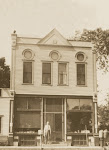
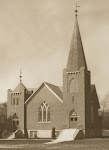
The early settlers made a wise decision to establish farms in the Norseland area. Our history book centers on the many families that settled and stayed here for many years and many generations. Some settlers did not stay. They moved to other areas. The August 23, 1873 issue of the St. Peter Tribune reports that Lewis Swenson sold his farm of 160 acres for $3,150 or $19.69 per acre. The farm was described as having 60 acres of timber and 50 acres of prairie under cultivation. There was a house and granary on the premises and it was located at the crossing of the St. Peter and New Auburn roads.
The 1855 Andrew Thorson letter indicated that timber land was selling for $16.00 an acre and prairie land for $1.25. This increase in land value, 1475% for the prairie ground, was extraordinary. These pioneers could reap substantial rewards for working hard and taking monumental risks.end
Tuesday, January 15, 2008


Sunday, December 30, 2007
A Centerfold and More!
The book committee is in the process of proofing and placing photos in appropriate sections. There are many wonderful photos for us to use. In fact, we plan on having several pages with only photos and captions. The committee, in good nature refers to this as our "centerfold". It may be of interest for you to know that our book contains 69 family/farm histories. This includes nine family farm stories where the farm has being in the same family for 150 years or more. We have had 111 individuals write stories for the book and we have 327 individual articles. The total word count is 171,000 words. end
Friday, December 7, 2007
Modern Cook Stove
In 1860, a early pioneer family wrote a letter back home to Norway telling about a cookstove that was multipurpose. "And we have bought a cooking stove which cost $36, and with that one we can cook, fry pork, bake bread and make coffee, all at the same time."
This information came from Svend Svensen and Guri Sandersdatter.
This information came from Svend Svensen and Guri Sandersdatter.
Tuesday, November 13, 2007
The Governor Ate Here
The story is told about "Burke's Black Lantern Cafe" which was a business establishment in Norseland during the 1930's. The cafe was a type of outside restaurant and was located across the street from the Norseland Store.
Sibley Burke, proprietor of the cafe, was considered a man ahead of his time and very flamboyant. Evidently, Floyd B. Olson, who later became the Governor or the state stopped at the Burke restaurant. He ordered an "onion sandwich". The cook was fresh out of onions and had to rob a neighbor's garden to fulfill the request. I imagine that made the sandwich taste even better. end
Sibley Burke, proprietor of the cafe, was considered a man ahead of his time and very flamboyant. Evidently, Floyd B. Olson, who later became the Governor or the state stopped at the Burke restaurant. He ordered an "onion sandwich". The cook was fresh out of onions and had to rob a neighbor's garden to fulfill the request. I imagine that made the sandwich taste even better. end
Sunday, October 21, 2007
Rivalries at District 46
"In that school the Swedes and Norwegians were equally divided with one German family and one half German family in the minority. I was half Norwegian and half Swedish, so I was the swing vote, although we never really argued about nationality except in fun. However, we did argue about breeds of cattle. Of course, the Swensons and others dominated with their Holsteins. My father had Shorthorns which weren't very highly regarded. The favorite comment we used to taunt the Holstein people with, was to say that they might as well milk the water tank!"
......Ruth Snyder Larson
......Ruth Snyder Larson
Saturday, October 13, 2007
4-H Club Congress
The Norseland 4-H has sent four outstanding 4-Hers to the national 4-H Club Congress. They were:
Jean Blomstin in 1946;
Grace Johnson in 1957;
Burt Johnson in 1962;
Karen Annexstad in 1969.
The Club Congress was the premier award for 4-Hers from all over the country. It was held every year sometime between Thanksgiving and Christmas. If my memory is correct, it was held at the Palmer House, a hotel of great distinction in Chicago, Illinois. end
Subscribe to:
Posts (Atom)
